Capture a world. Let the models move it.
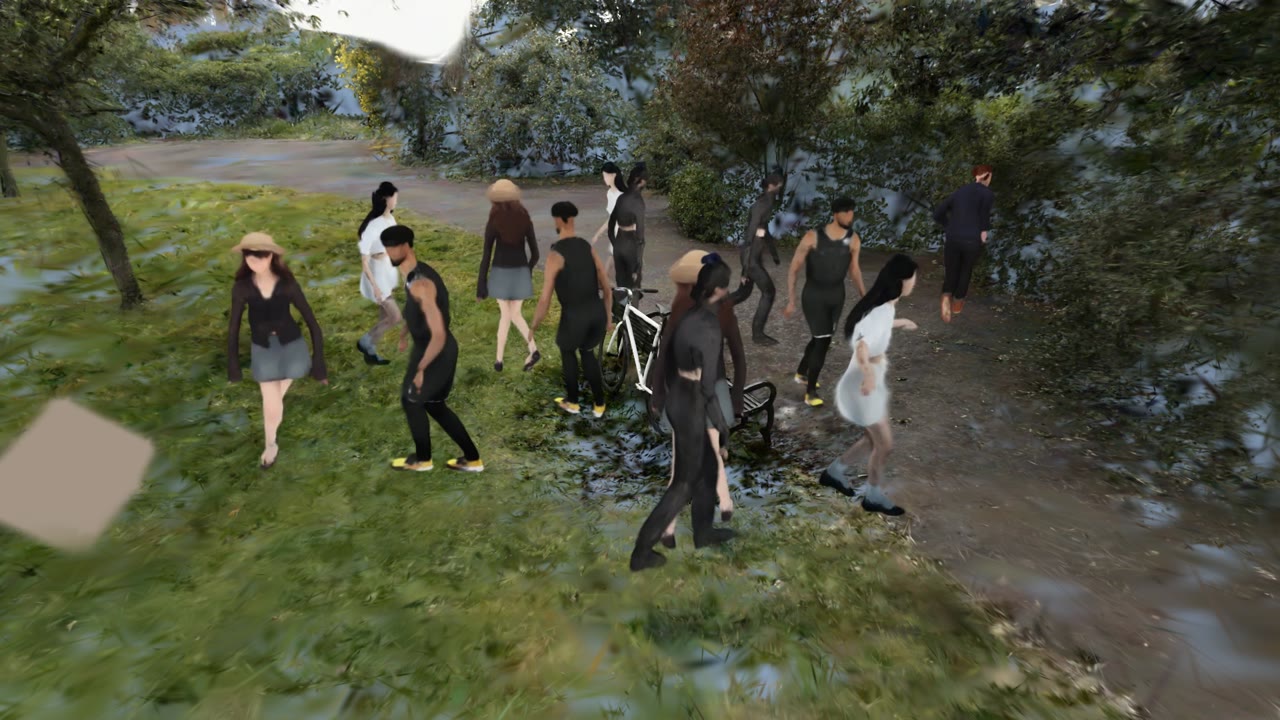
Wakefold is a game engine for captured 3D Gaussian-splat worlds. Physics, crowds and characters are predicted by learned models, with thin classical guards that keep them playable. A game model directs the scenario; every run plays out differently.
Three layers, one rule: nothing moves by hand-written physics
Classical code stays only where real-time play needs it: the player controller, collision queries and the safety guards around each model. Everything else is learned, and everything you cannot see is simulated coarser or not at all.
Capture
Levels are Gaussian-splat captures with a baked collision field and walkable navigation. Props, avatars and swaying plants are packages with their own learned dynamics.
Predict
Small models on the CPU predict interacting props, swaying regions, crowds and character motion every tick. Batched, fixed-shape calls make replays byte-identical across machines.
Direct
A game model reads a scenario and the world state and decides the small things: who walks where, who grabs the bike and rides off. The engine's models make it happen.
Measured on the slice, not promised
From the latest scripted 60-second run on the bicycle level: the player, 12 walkers, a learned crate and a learned bush, rendered every frame at 1920×1080.
| Check | Result | Gate |
|---|---|---|
| Frame time, median | 4.4 ms | 16.7 ms (60 fps) |
| Character animation, per character (p99) | 0.19 ms | 2 ms |
| Foot slide per contact frame | 0.30 cm | 1.5 cm |
| Control latency | 2 frames | 3 frames |
| Reaction to a shove | 1 frame | 3 frames |
| Replay on another machine | byte-identical | within 1 cm |
Measured on a cloud NVIDIA A10G (the same GA102 chip family as the RTX 3080 target). Estimated RTX 3080 frame time: 4–5 ms.
Where it is going
- P0–P2Done
Captured level, reactive props, characters
Splat renderer on CUDA with a Vulkan presenter, learned crate and bush, Gaussian avatars with motion matching and learned motion matching.
- P3In progress
Many entities
Interacting props that stack, topple and roll, pick-up and throw, push reactions, culling and level of detail for everything unseen.
- NextPlanned
The game model
Scenario in, non-deterministic play out: intents for characters, vehicles and props, chosen by a model and carried out by the engine.
- LaterPlanned
Generative suite
Build a playable level from a prompt, pictures or a video, with props and characters that already know how to move.
The alpha is free to use
- Free for personal and commercial prototypes during the alpha.
- The engine is not open source; builds and docs come with an alpha licence.
- Needs an NVIDIA GPU of the RTX 3080 class (10 GB) on Windows or Linux.
- Expect rough edges: formats and model contracts will still change.